




Football—also known as association football or soccer—is the world’s most popular sport. It is governed by the IFAB (International Football Association Board), which publishes the Laws of the Game. While the game looks simple—score more goals than the opponent—it has detailed rules covering everything from offside to VAR.
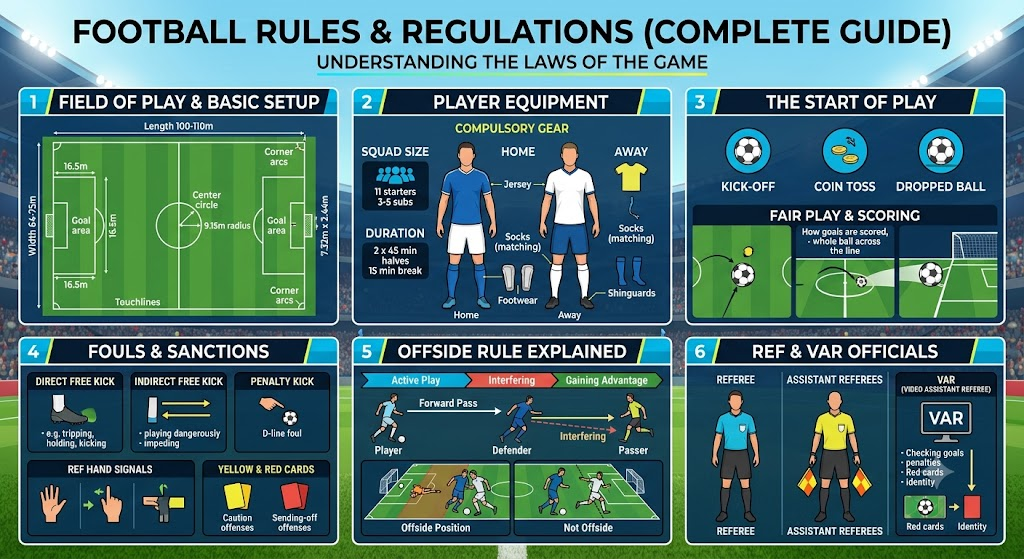
This guide explains the core rules and regulations of football in a clear, complete way.
1. The Basics
Football is played between two teams of 11 players each, including one goalkeeper. The objective is to score more goals than the opposing team.
Matches are played on a rectangular field called the pitch.
Each team defends one goal.
The team with the most goals at the end wins.
If scores are level, the match can end as a draw, or go to extra time and penalties depending on the competition.
Pitch Dimensions
Length: 90–120 metres (100–110m for international matches)
Width: 45–90 metres (64–75m for international matches)
Goal size: 7.32 metres wide × 2.44 metres high
The pitch includes:
Halfway line and centre circle
Penalty areas and goal areas
Corner arcs
Penalty spots
2. The Ball and Equipment
The ball must be spherical, with a circumference of 68–70 cm and weight of 410–450 g (Size 5 for adults).
Players wear jerseys, shorts, socks, shin guards, and boots.
Goalkeepers must wear a different colour from outfield players and the referee.
Jewellery is generally not allowed.
3. Match Duration
A standard match lasts 90 minutes, divided into two 45-minute halves.
Half-time interval: 15 minutes.
The referee adds stoppage time for injuries, substitutions, VAR checks, goal celebrations, and time-wasting.
In knockout competitions, if scores are level:
Extra time: two 15-minute periods.
Penalty shootout if still level.
4. Players and Substitutions
Each team starts with 11 players, including a goalkeeper.
A team must have at least 7 players to continue. If fewer, the match is abandoned.
Substitutions are allowed based on competition rules. Most major competitions allow 5 substitutions in 3 windows (plus half-time).
Concussion substitutions are increasingly permitted in many competitions.
5. Match Officials
The match is controlled by:
Referee – main authority, enforces laws, issues cards.
Assistant referees – assist with offside, throw-ins, and ball out of play.
Fourth official – manages substitutions and added time.
VAR (Video Assistant Referee) – reviews clear and obvious errors.
The referee’s decision is final, though VAR can overturn mistakes in specific situations.
6. Scoring a Goal
A goal is scored when the whole ball crosses the goal line between the posts and under the crossbar, provided no offence has been committed by the scoring team.
Goals can be scored from open play, free kicks, penalties, corners, and kick-offs.
A goal cannot be scored directly from a throw-in.
A goal cannot be scored directly from an indirect free kick.
7. Starting and Restarting Play
Kick-Off
Starts each half and restarts after a goal.
Ball is stationary on the centre spot.
All players must be in their own half; opponents must be 9.15m away.
The ball is in play once kicked and clearly moves.
Throw-In
Awarded when the ball crosses the touchline.
Taken with both hands, ball delivered from behind and over the head.
Both feet must be on or behind the touchline.
Goal Kick
Awarded when the ball crosses the goal line last touched by an attacker.
Taken from the goal area.
Ball is in play once kicked and clearly moves.
Corner Kick
Awarded when the ball crosses the goal line last touched by a defender.
Taken from the corner arc.
Opponents must stay 9.15m away.
Free Kicks
Direct free kick: a goal can be scored directly.
Indirect free kick: ball must touch another player before a goal counts.
Opponents must be at least 9.15m away.
Dropped Ball
Used to restart play when the referee stops the game for an injury, outside interference, or a ball touching the referee.
The ball is dropped to the team that last touched it, at the position where play stopped.
8. The Offside Rule
Offside is one of football’s most misunderstood rules. A player is offside if:
They are in the opponent’s half.
They are nearer to the opponent’s goal line than both the ball and the second-last opponent.
They become involved in active play by:
Interfering with play
Interfering with an opponent
Gaining an advantage from being in that position
A player is not offside if:
They are level with the second-last opponent.
They receive the ball directly from a goal kick, throw-in, or corner.
They are in their own half.
Offside is judged at the moment the ball is played by a teammate.
9. Fouls and Misconduct
Direct Free Kick Offences
A direct free kick is awarded if a player commits any of these carelessly, recklessly, or with excessive force:
Kicking or attempting to kick
Tripping
Jumping at
Charging
Striking or attempting to strike
Pushing
Tackling
Holding
Spitting or biting
Throwing an object
Handball
If the offence occurs inside the penalty area, a penalty kick is awarded.
Indirect Free Kick Offences
Dangerous play
Obstructing an opponent without contact
Goalkeeper holding the ball for more than six seconds
Goalkeeper handling a deliberate backpass or throw-in from a teammate
Offside
Handball
Handball is an offence when a player:
Deliberately touches the ball with their hand or arm
Scores or creates a goalscoring opportunity immediately after an accidental handball
Makes their body unnaturally bigger with the arm
The arm’s position and movement are key factors.
10. Yellow and Red Cards
Yellow Card – Caution
A player is cautioned for:
Unsporting behaviour
Dissent
Persistent fouling
Delaying the restart
Not respecting required distance
Entering or leaving the field without permission
Two yellow cards in one match = red card.
Red Card – Dismissal
A player is sent off for:
Serious foul play
Violent conduct
Spitting or biting
Denying an obvious goalscoring opportunity (DOGSO) by handball
Denying an obvious goalscoring opportunity by a foul
Abusive language or gestures
Second yellow card
A sent-off player cannot be replaced.
11. Penalty Kicks
A penalty kick is awarded when a player commits a direct free kick offence inside their own penalty area.
Procedure:
Ball placed on the penalty spot.
Only the goalkeeper and the kicker are involved.
Goalkeeper must have at least part of one foot on the goal line until the ball is kicked.
All other players must be outside the penalty area and at least 9.15m from the ball.
The kicker must not touch the ball again until another player touches it.
12. VAR – Video Assistant Referee
VAR can review four match-changing situations:
Goals
Penalty decisions
Direct red cards
Mistaken identity
VAR only intervenes for clear and obvious errors or serious missed incidents. The referee can review footage on the pitch-side monitor or accept VAR’s recommendation.
13. Extra Time and Penalty Shootouts
In knockout matches:
If scores are level after 90 minutes, extra time is played: two 15-minute halves.
If still level, a penalty shootout decides the winner.
Penalty Shootout Rules
Teams alternate taking five kicks each.
If still level after five, it goes to sudden death.
Only players on the field at the end of extra time are eligible.
Goalkeepers can be swapped if a team has unused substitutions.
14. Competition Regulations
Beyond the Laws of the Game, each competition has its own rules:
League: points for win (3), draw (1), loss (0). Tiebreakers include goal difference, goals scored, head-to-head record.
Cup: knockout format with extra time and penalties.
Promotion, relegation, and playoffs vary by country.
Financial Fair Play, squad limits, and licensing rules apply in professional leagues.
Disciplinary records can lead to suspensions.
Major competitions include:
FIFA World Cup
UEFA Champions League
Premier League
Copa América
Africa Cup of Nations
Indian Super League
15. The 17 Laws of the Game
For reference, the official Laws are:
Field of Play
The Ball
The Players
The Players’ Equipment
The Referee
Other Match Officials
Duration of the Match
Start and Restart of Play
Ball In and Out of Play
Method of Scoring
Offside
Fouls and Misconduct
Free Kicks
Penalty Kick
Throw-In
Goal Kick
Corner Kick
Conclusion
Football’s rules are designed to keep the game fair, safe, and exciting. While the basic idea is simple—score more goals than your opponent—the laws cover everything from offside and handball to VAR and penalty shootouts. Once you understand the flow of the match, the role of the referee, and the key restarts, the game becomes much easier to follow and enjoy.
Whether you are playing, coaching, or watching, knowing the rules makes football far more rewarding.