






Cricket is often described as a complex sport wrapped in a simple premise: hit the ball, run, and score more points than the other team. However, with its unique terminology, various formats, and intricate laws, it can be daunting for newcomers.
Whether you are trying to understand the sport for the first time or looking to brush up on the finer points, this guide breaks down the essential rules and regulations of the game.
1. The Basics: The Objective
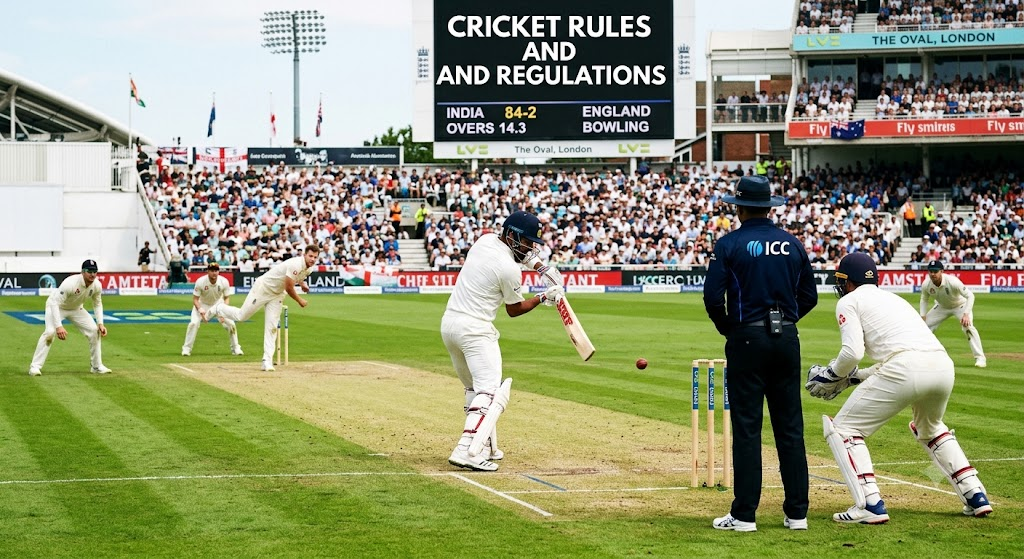
Cricket is a bat-and-ball game played between two teams of 11 players each. The primary objective is to score more runs than the opposing team.
The Pitch: The game is played on a field with a rectangular 22-yard strip in the center called the pitch.
The Wickets: At each end of the pitch, there are three wooden stumps topped by two bails. This structure is called the wicket.
2. The Formats
Modern cricket is governed by the ICC (International Cricket Council) and is played in three primary formats, each with slight variations in rules regarding duration:
Test Cricket: The traditional format. It lasts up to five days, with two innings per team. There are no limits on the number of overs (sets of six balls) bowled in an innings.
One Day International (ODI): A limited-overs format where each team faces a maximum of 50 overs. It is completed in a single day.
T20 (Twenty20): The shortest format. Each team faces a maximum of 20 overs. It lasts about three hours and is known for aggressive batting.
3. How the Game is Played
A match consists of Innings. In limited-overs cricket, each team gets one innings (batting and bowling) unless the match is shortened by rain.
Toss: The captains toss a coin. The winner chooses whether to bat or bowl first.
Batting: Two batsmen are on the field at a time. One stands at the striker’s end (facing the bowler), and the other is at the non-striker’s end.
Bowling: The bowler delivers the ball to the batsman. A "spell" is a series of overs bowled by a player.
The Over: An over consists of six legal deliveries. After six balls, a different bowler must bowl from the opposite end of the pitch.
4. Scoring Runs
Runs are the currency of cricket. Teams accumulate runs through various methods:
Running: After a batsman hits the ball, the two batsmen run between the wickets. Each completed length is one run. They can run multiple times if the ball is hit far.
Boundaries:
Four (4): If the ball touches the ground and crosses the boundary rope, the batting team gets 4 runs.
Six (6): If the ball clears the boundary rope on the full (without touching the ground), the batting team gets 6 runs.
Extras: Runs awarded to the batting team for bowler errors (Wides, No-Balls) or ball mishaps (Byes, Leg-Byes).
5. How to Get Out (Dismissals)
An innings ends when 10 batsmen are dismissed (since batsmen play in pairs, the 11th man cannot bat alone). There are ten ways to be dismissed, but these are the most common:
Bowled: The bowler hits the stumps with the ball, and the bails fall off.
Caught: A fielder catches the ball hit by the batsman before it touches the ground.
Leg Before Wicket (LBW): The ball hits the batsman’s leg (pad) when it would have otherwise hit the stumps.
Run Out: The batsmen attempt a run, but the fielding team hits the stumps with the ball before the batsman can reach the crease.
Stumped: The batsman steps out of their crease to hit the ball, misses, and the wicketkeeper knocks the bails off.
Hit Wicket: The batsman accidentally hits their own stumps with their bat or body.
6. Key Regulations and Terminology
The Powerplay
In limited-overs cricket (ODI and T20), the first few overs are called the Powerplay. During this time, fielding restrictions are strict: only a certain number of fielders are allowed outside the inner circle. This encourages aggressive batting and scoring.
Wides and No-Balls
Wide: If the bowler bowls the ball too far away from the batsman for them to hit it (in the umpire's opinion), it is called a Wide. The batting team gets 1 extra run, and the ball must be re-bowled.
No-Ball: If the bowler oversteps the crease line, it is a No-Ball. This gives the batting team 1 extra run, a "free hit" (where the batsman cannot be dismissed except by run-out), and the ball is re-bowled.
DRS (Decision Review System)
Most professional matches use DRS. Teams are allowed a limited number of reviews per innings. If a player is given "Out" or "Not Out" by the on-field umpire, the captain can signal for a review. The third umpire uses technology (Hawk-Eye, UltraEdge) to determine if the decision was correct. If the decision stands, the team loses a review.
Over Rates
Teams are expected to bowl their overs at a specific pace. If a team is too slow (e.g., not completing 50 overs in the allotted time), the captain may face fines or suspensions.
7. Fielding Positions
While there are no rules on where fielders must stand (except during Powerplays), specific positions have specific names. Understanding these helps you follow the game:
Slip: Behind the batsman, waiting for an edge.
Point: Square of the wicket on the off-side.
Cover: In front of Point.
Mid-off / Mid-on: Straight down the ground on either side of the bowler.
Fine Leg: Behind the batsman on the leg side.
8. Ways to Win
Win by Runs: If Team A bats first and scores 200, and Team B is bowled out for 150, Team A wins by 50 runs.
Win by Wickets: If Team A bats first and scores 200, and Team B chases it down (e.g., scores 201) while losing only 4 batsmen, Team B wins by 6 wickets.
Tie: If both teams score the exact same number of runs.
Draw: Unique to Test Cricket. If the match runs out of time (5 days) and the team batting last has not been bowled out and is not ahead in score, the match is a Draw.
Conclusion
Cricket is a game of strategy, patience, and sudden explosions of action. While the laws are extensive, the core mechanics—scoring runs and taking wickets—remain simple. Once you understand the flow of an over and the value of a wicket, the game's unique beauty becomes apparent.